
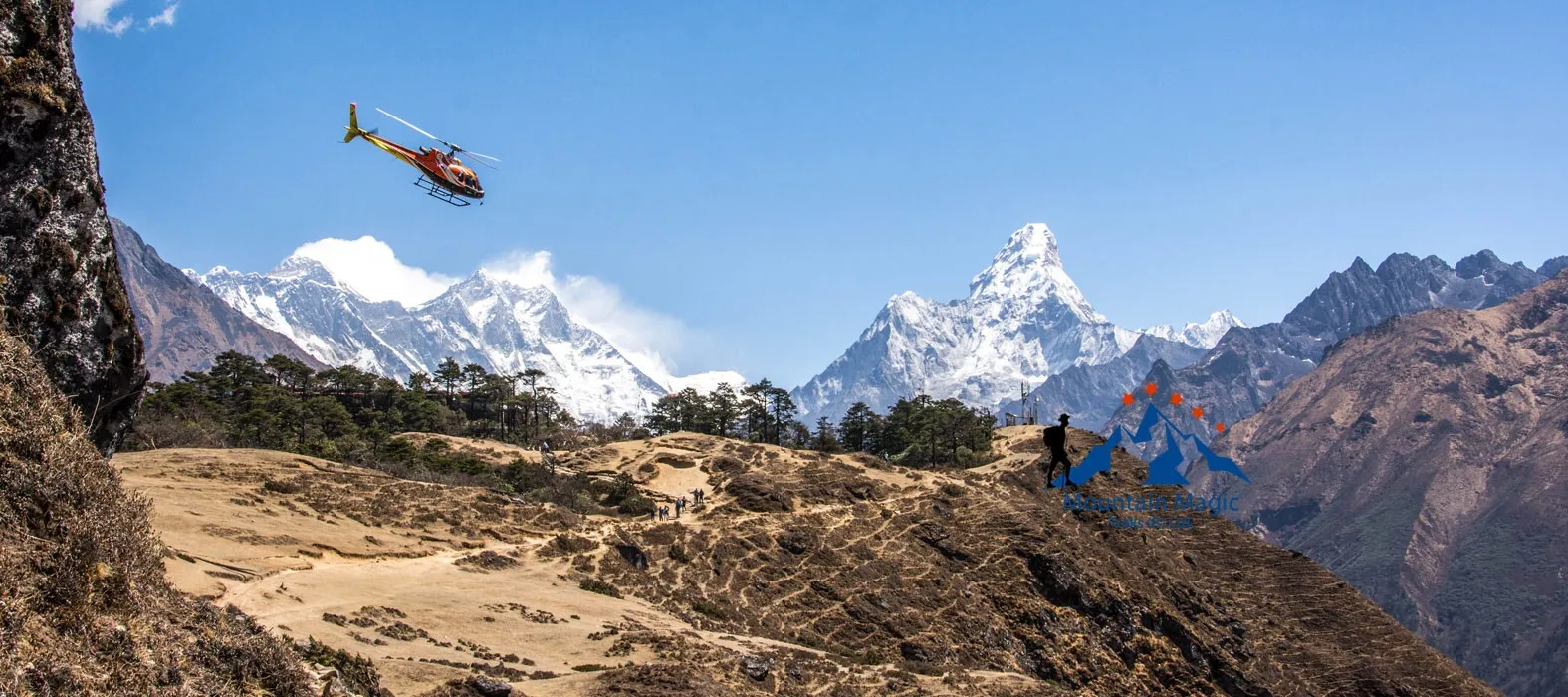
The last few days of an Everest trek are not like the first few days.
The green hills are far behind. Trees become rare. The air feels thinner, the paths are more rocky, and every step needs more effort. Yet this is also when the goal finally feels close.
The Everest Base Camp Trek With Helicopter Return is designed around this important part of the journey. You walk through the high Khumbu region, reach Everest Base Camp, climb Kala Patthar, and then leave the mountains by helicopter instead of walking the full route back.
The result is a trek where the final days are focused on the biggest moments rather than a long return walk.
When the Mountains Become More Serious
After Dingboche, the character of the trail changes.
You are walking at elevations where your body has to work harder. The landscape is wide and open, with fewer trees and large rocky slopes around you.
From Dingboche, the route continues toward Lobuche. Along the way, the views of peaks such as Pumori, Nuptse, and Lobuche East become more impressive.
But the scenery should not distract you from the altitude.
The higher you go, the more important it becomes to walk slowly and listen to your guide.
The Stop at Thukla Has Meaning
Thukla is more than a place to stop for a drink.
Above the settlement is the Thukla Pass, where memorials honor climbers and mountaineers who lost their lives in the Everest region.
The area is quiet and surrounded by huge mountains.
It can be an emotional part of the Everest Base Camp Trek With Helicopter Return because it reminds trekkers that these mountains are beautiful but also demanding.
Standing there can change the way you look at the peaks ahead.
You stop thinking only about getting a photograph and start thinking about the people who came here before you.
Lobuche Brings You Close to the Goal
From Thukla, the trail continues toward Lobuche.
The surroundings now have a much more rugged appearance. The Khumbu Glacier becomes a major feature, and the high peaks seem much closer.
Lobuche is an important overnight stop before the long day to Everest Base Camp.
This is a good time to keep things simple.
Eat your meal. Drink enough water. Prepare your daypack. Get as much rest as possible.
The next day is one of the biggest days of the entire trek.
The Base Camp Day Is Long for a Reason
The route from Lobuche to Gorakshep and then Everest Base Camp takes several hours.
According to the published itinerary, the walking section from Lobuche to Gorakshep, Base Camp, and back covers around 15 kilometers and can take roughly 7 to 9 hours.
That number may not sound extreme at sea level.
At more than 5,000 meters, it is a different story.
The best approach is to forget about speed. Keep a steady rhythm and take short breaks when needed.
Gorakshep Is the Last Main Stop
Gorakshep sits at around 5,125 meters and is the final settlement used before reaching Base Camp on this itinerary.
Most of your heavier belongings can stay at the lodge while you continue with a smaller daypack.
That makes sense.
You do not need unnecessary weight when walking toward Everest Base Camp.
Carry water, warm layers, basic personal items, and anything you need for the day.
Reaching Everest Base Camp Is Only Part of the Story
The trail toward Base Camp follows a landscape shaped by ice and rock.
The Khumbu Glacier and surrounding peaks make the final approach feel very different from the lower sections of the trek.
When you arrive, give yourself time to take it in.
Take photographs if you want them. Look around. Notice the glacier and the mountains instead of immediately thinking about the next step.
You have spent days walking toward this place.
Enjoy the moment.
The Early Morning Climb to Kala Patthar
The next major experience comes from a different direction.
Kala Patthar is known for its close views of Mount Everest and the surrounding peaks. The published itinerary places its highest point at about 5,545 meters.
The climb is usually done early in the morning.
Why so early?
Because sunrise can create a completely different view of the mountains.
The first light reaches the peaks while the valleys remain darker. Everest, Pumori, Nuptse, and nearby mountains can stand out sharply against the morning sky.
Do Not Rush the View
The climb may be short compared with the entire trek, but the altitude makes it demanding.
Walk carefully.
There is no benefit in racing to the top.
Once you reach Kala Patthar, take a moment to look around. This is one of the places where the scale of the Everest region becomes easiest to understand.
Glaciers, ridges, valleys, and high peaks spread out in every direction.
Then Comes the Unusual Ending
This is where the Everest Base Camp Trek With Helicopter Return becomes different from a standard Everest Base Camp route.
Instead of beginning another long walking journey back toward Lukla, you prepare for the helicopter.
The published itinerary states that the flight from Gorakshep toward Kathmandu takes about 1.5 hours of flying time in clear conditions, although the actual journey can vary because of weather and operational needs.
The helicopter may also make a stop around Lukla before continuing toward Kathmandu.
That means the final part of your trip is not spent retracing every trail you already walked.
The Return Flight Shows the Journey Differently
For several days, you have looked at the Himalayas from ground level.
Now you see them from above.
The trail becomes a thin line. Villages appear small. Rivers cut through deep valleys. Glaciers and ridges that looked enormous from the ground become part of a much wider picture.
This is one of the strongest reasons to choose an Everest Base Camp Trek With Helicopter Return.
The flight does not replace the trek.
It gives you a final way to understand it.
Weather Is Part of the Plan
There is one thing trekkers should never forget: mountain flights depend on conditions.
Cloud, wind, visibility, and other factors can affect helicopter operations.
The trip page also warns that actual flight times can change with weather.
So keep your schedule flexible.
Do not treat a mountain flight like a train that will leave at exactly the same time every day.
A little patience can prevent a lot of stress.
FAQs
How difficult are the final trekking days?
They are among the more demanding parts of the route because of the high altitude. The distance is only one factor; the elevation makes walking harder.
What is the highest point of the trek?
Kala Patthar is listed at approximately 5,545 meters on the published itinerary.
Do you walk back from Everest Base Camp?
You return to Gorakshep after visiting Base Camp. After the Kala Patthar hike, the helicopter is used for the return toward Kathmandu.
Can the helicopter return be delayed?
Yes. Weather and flying conditions can cause delays. Travelers should leave some flexibility in their schedule.
Conclusion
The Everest Base Camp Trek With Helicopter Return saves its biggest experiences for the final part.
The trail becomes rougher, the air gets thinner, and the mountains feel closer. You pass the memorials at Thukla, spend time in Lobuche, reach Gorakshep, walk to Everest Base Camp, and climb Kala Patthar for a wider Himalayan view.
Then the direction changes.
Instead of spending several more days walking away from Everest, you rise above the landscape by helicopter.
After seeing the Himalayas step by step, you finally see the entire journey from the sky.
